Techno-Authoritarianism Part One: The Despots of Silicon Valley
How did people like Elon Musk, Marc Andreessen, Peter Thiel, and Mark Zuckerberg become so powerful? Conventional wisdom tells us that they are geniuses — singular great men who pulled themselves up by their bootstraps and bottled lightning as they invented consequential technologies and services that increasingly mediate every aspect of life. Conventional wisdom also says that they are rational, unbiased technologists who just want to get rich while providing us with modern conveniences and cool tech. But dig a bit deeper, and you’ll soon discover that they are not geniuses, did not pull themselves up by their bootstraps, and are far from unbiased. In the past year, they have unmasked themselves as techno-authoritarian ghouls hell bent on taking over the world, fleecing the public of tax dollars, and pulling up the ladder behind them while decrying anything that even looks like regulation and oversight as the end of America. In a series of short pieces, I will cover the rise of techno-authoritarianism, how we got here, and crucially, what’s at stake when these very same techno-authoritarians are also the dominant purveyors of the education technology millions of children and adolescents use every day in school.
The Despots of Silicon Valley
Cybersecurity researcher Justin Sherman studies techno-authoritarianism (also called digital authoritarianism) in the context of national security, viewing its development in China and Russia as a growing threat to the United States:
Digital authoritarianism, at its core, is a mechanism for exerting increased, unchecked control over one’s population through digital technologies. Censorship, device hacking, and mass surveillance are all on the table. In this way, digital authoritarianism facilitates power consolidation — ensuring that challenges to a regime are outed in advance or quickly observed as they arise, and suppressed .¹
This statement is filled with cybernetic, Cold War concepts, such as control and surveillance. Researchers like Sherman are trained to address threats beyond America’s borders, but it is crucial to examine how this is happening within the United States.
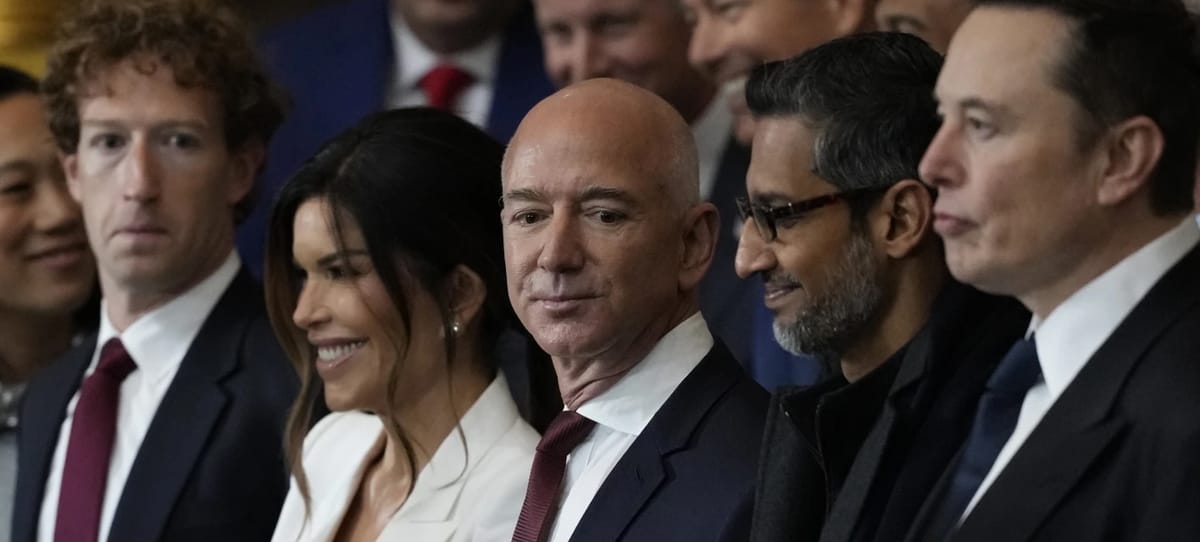
The rise of US techno-authoritarianism, most prominently exemplified by tech CEOs and venture capitalists (VCs) such as Elon Musk, Marc Andreessen, and Mark Zuckerberg, has been in no small part made possible by the wealth they have derived from the products created by the companies they helm.² But their interests extend beyond wealth generation. Not content to get rich and enjoy the spoils of industry, the techno-authoritarians of Silicon Valley are potent political operators.³ Fearful of regulation, antitrust investigations, and increased taxes, they fund the political aspirations of figures like Donald Trump and set the social and political course of the United States.⁴ The interrelationship between Trump and the techno-authoritarians of Silicon Valley was prominently on display during the US presidential inauguration on January 20, 2025. In seats normally reserved for the president’s family, past presidents, and potential cabinet members, the CEOs of Meta (parent company of Facebook, Instagram, Oculus, and WhatsApp), Amazon, Alphabet (parent company of Google), and OpenAI gleefully showed their support of Trump.⁵ These Silicon Valley techno-authoritarians own or control most of the tools for communication that have come to seem inevitable, indispensable, and culturally necessary.⁶ Via social media, these same techno-authoritarians control the most powerful forms of public discourse, which they shape through algorithmic tailoring: they amplify ideas or discourse they favor and suppress those they deem dangerous or that conflict with their objectives.⁷ For example, one study alleges algorithmic manipulation in favor of Republican and right-leaning content on the social media platform X in the run-up to the 2024 United States presidential election⁸, while another shows similar manipulation on the social media platform TikTok during the same period.⁹
Silicon Valley techno-authoritarians, ever vigilant for new forays in profit-making and displays of power, have turned their attention to military procurement as a substantial source of revenue. Meta, Oracle, Amazon, Coinbase, and Palantir made substantial donations to Trump’s June 2025 military parade, a spectacle that sought to align Trump with the US military’s might.¹⁰ Palantir Technologies, Inc., has to date been awarded $908 billion for software that will enable the Trump administration to turn its gaze inward to create digital composites of American citizens via new spying technologies deployed primarily at the Department of Homeland Security and the Health and Human Services Department.¹¹ IBM, Microsoft, and Oracle have long been military contractors; however, since Trump took office again in 2024, OpenAI, Meta, Anthropic, and Amazon have all announced military partnerships with the White House and the Department of Defense.¹² These developments follow quiet sea changes within companies that formerly pledged not to use tools like AI for military or policing applications. In February 2024, Google dropped its promise not to pursue any tech that might “cause or are likely to cause overall harm”.¹³ OpenAI, whose stated mission is “to ensure that artificial general intelligence benefits all of humanity”¹⁴ last year surreptitiously removed language banning “activity that has high risk of physical harm, including, weapons development, military, and warfare” from its usage policy.¹⁵ Meta and Anthropic have followed suit, particularly after lucrative partnerships with companies like Anduril were announced.¹⁶ Perhaps the most stunning indicator of the depth in which Silicon Valley techno-authoritarians have involved themselves in the US military is the creation of Detachment 201. The US Army “is establishing Detachment 201: The Army’s Executive Innovation Corps, a new initiative designed to fuse cutting-edge tech expertise with military innovation”.¹⁷ This initiative made Army Reserve lieutenant colonel of four technology executives: Shyam Sankar, Chief Technology Officer for Palantir; Andrew Bosworth, Chief Technology Officer of Meta; Kevin Weil, Chief Product Officer of OpenAI; and Bob McGrew, advisor at Thinking Machines Lab and former Chief Research Officer for OpenAI, clearing the way for these individuals to “work on targeted projects to help guide rapid and scalable tech solutions to complex problems” and “inspire more tech pros to serve without leaving their careers, showing the next generation how to make a difference in uniform”.¹⁸
***Next: In the next piece, I will detail how all of this fits into a long and predictable arc, originating with lionized figures like William Shockley, Jr., a Bell Labs alumnus, inventor of the junction transistor, and a Nobel Prize winner (physics). He was also a rabid eugenicist and a media darling who used his fame as a very public cheerleader for scientific racism.
[1] Sherman, J. (2021). Digital authoritarianism and implications for US national security. The Cyber Defense Review, 6(1), 107–118.
[2] LaFrance, A. (2024, February 28). The rise of techno-authoritarianism. The Atlantic. https://www.theatlantic.com/magazine/archive/2024/03/facebook-meta-silicon-valley-politics/677168/.
[3] Okumus, S. (2022). The Rising Political Power of Silicon Valley. Fiker Institute.
[4] Roose, K. (2024, November 6). What a Trump Victory Means for Tech. The New York Times. https://www.nytimes.com/2024/11/06/technology/trump-musk-ai-crypto.html.
[5] Helmore, E. (2025, January 21). Trump inauguration: Zuckerberg, Bezos and Musk seated in front of cabinet picks. The Guardian. https://www.theguardian.com/us-news/2025/jan/20/trump-inauguration-tech-executives.
[6] Silicon Valley Map — a map of tech companies and start-ups in Silicon Valley and San Francisco. (n.d.). https://www.siliconvalleymap.org/. Accessed 9 May 2025.
[7] Aytac, Ugur (2024). “Digital domination: Social media and contestatory democracy.” Political Studies 72, no. 1 (2024): 6–25.
[8] Graham, T., & Andrejevic, M. (2024). A computational analysis of potential algorithmic bias on platform X during the 2024 US election.
[9] Ibrahim, H., Jang, H. D., Aldahoul, N., Kaufman, A. R., Rahwan, T., & Zaki, Y. (2025). TikTok’s recommendations skewed towards Republican content during the 2024 US presidential race. arXiv preprint arXiv:2501.17831.
[10] Nguyen, T. (2025, June 12). Big Tech quietly sponsors Trump’s military parade party. The Verge. https://www.theverge.com/policy/685690/big-tech-trump-military-parade-america250
[11] Frenkel, S., & Krolik, A. (2025, May). Trump Taps Palantir to Compile Data on Americans. The New York Times. https://www.nytimes.com/2025/05/30/technology/trump-palantir-data-americans.html
[12 ] Chen, B. J., Park, T. M., & Pasternack, A. (2025, June 20). Booming Military Spending on AI is a Windfall for Tech — and a Blow to Democracy. Tech Policy Press. https://www.techpolicy.press/booming-military-spending-on-ai-is-a-windfall-for-tech-and-a-blow-to-democracy/
[13] Tiku, N., & De Vynck, G. (2024, February). Google drops pledge not to use AI for weapons or surveillance. The Washington Post. https://www.washingtonpost.com/technology/2025/02/04/google-ai-policies-weapons-harm/
[14] OpenAI | About. (n.d.). OpenAI. https://openai.com/about/
[15] Biddle, S. (2024, January 17). OpenAI quietly deletes ban on using ChatGPT for “Military and warfare.” The Intercept. https://theintercept.com/2024/01/12/open-ai-military-ban-chatgpt/
[16] Chen, B. J., Park, T. M., & Pasternack, A. (2025, June 20). Booming Military Spending on AI is a Windfall for Tech — and a Blow to Democracy. Tech Policy Press. https://www.techpolicy.press/booming-military-spending-on-ai-is-a-windfall-for-tech-and-a-blow-to-democracy/
[17, 18] Army launches Detachment 201: Executive Innovation Corps to drive tech Transformation. (2025, June 13). www.army.mil. https://www.army.mil/article/286317/